.avif)
At MEP, expansion has never really been the goal. There are many places we know well — both personally and professionally — but that doesn’t automatically mean we should operate there. The question has always been simpler than that: where can we genuinely create value?
That’s what led us to Baku.
On the surface, it’s a very natural extension of Türkiye. There’s a strong cultural proximity, a shared sense of how things work, and in many cases, overlapping professional networks. The language feels familiar, the business environment is not far removed, and across the hospitality sector, there are already strong connections — including a noticeable presence of Turkish professionals in leadership roles.
But familiarity alone is never a reason to expand.
What made Baku interesting to us was the gap between what has been built, and how it is experienced.
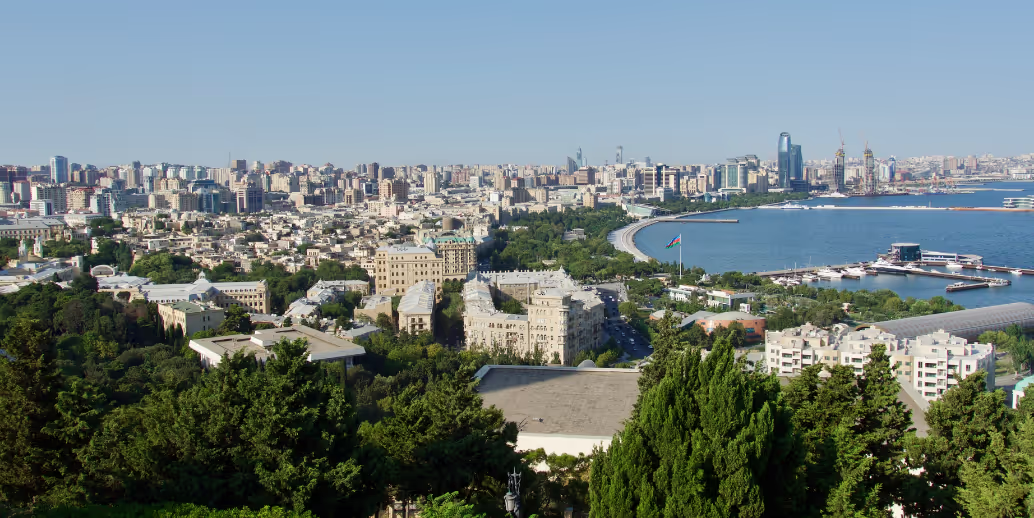
The city has seen serious investment over the past decades. The infrastructure is there — from the airport to the road systems, from internationally branded hotels like Four Seasons and Fairmont Flame Towers to cultural landmarks such as the Heydar Aliyev Center. The Old Town has been carefully restored, and there is a clear sense that the country has chosen to invest in both its history and its future. It’s safe, it’s modern, and in many ways, it’s extremely well prepared.
And yet, from a MICE perspective, it is still evolving.
Baku has long been a business destination, primarily driven by regional travel and corporate activity. What it hasn’t fully developed yet is the layer that sits on top of that — the structuring of experiences, the refinement of delivery, the small but critical details that define international programmes. You can find excellent restaurants, for example, but the idea of a structured event package — how a dinner flows, how it’s priced, how it’s experienced — is not always built into the system. For our world, those details matter.
That’s where we felt we could contribute.
From the beginning, we approached Baku not as something to replicate, but as something to work within. We didn’t go in trying to position ourselves as the ones who “know best.” Quite the opposite. We worked directly with local suppliers — hotels, guides, transport companies — and built strong relationships with trusted partners on the ground. Because ultimately, a destination is never something you fully own. You have to belong to it, at least in part.
At the same time, we brought what we know well: international expectations, structure, and the ability to design programmes that work not just on paper, but in reality.
Over time, this has translated into a range of work across the destination. We’ve delivered conferences and incentive programmes for international clients, moved large groups from Türkiye and the Middle East into Baku, and supported sponsor and hospitality programmes around major sporting events. At one point, we even relocated a 500-person incentive programme from Istanbul to Baku the following year. More recently, during COP29, we were involved in programmes for global private equity firms, consulting groups, media organisations and investment players — many of them already part of our wider client base.
That continuity has been important. It allowed us to build on relationships we already had, while gradually deepening our understanding of the destination itself.
What has probably surprised us most is not what Baku lacks, but how quickly it adapts. There is a real openness among local partners to collaborate, adjust, and improve. Combined with the level of investment the country has already made, it creates a destination that feels very much in motion.
At the same time, it has reinforced something we strongly believe: Baku is not for every programme — and that’s exactly why it works for the right one.
For us, this was never about scale. It was about being present in a place where we knew we could add something meaningful. We don’t aim to be everywhere. But in the places we choose to operate, we want to be relevant.
And increasingly, Baku is becoming one of those places.